
Between Seasons: Entry 4
Between Seasons is my journal while the podcast rests. Season 2 of The Redeemed Perfectionist podcast returns in January (though watch for a bonus episode December 15!), and until then, I'm taking you along as I build what's next.

God formed the frame. The picture depends on the source.
I didn’t know I was a perfectionist until 2019.
I thought I was just doing what God expected of me. I wasn’t really conscious that those were my expectations, not His.
That was the year the Lord began connecting the dots for me. In that same season, He was showing me His real heart for me, a perfect love that casts out fear (1 John 4:18). He began to reveal His true grace, what it meant, and the reality of a “counterfeit gospel” (Galatians 1:6-8). You’d think that would have taken care of the perfectionism. It didn’t.
As a matter of fact, at first I thought His voice was the counterfeit! Seriously.
I could have quoted you every verse on grace, and my body didn’t believe a word of it. Because I did what perfectionists do. I took grace and made it a self-improvement project. Do more. Be more. Do better. Instead of abiding in Him.
My motives may have been sincere and pure for where I was at that time. My methods were way off. Little did I realize that I was trying to sustain, by my own works, the salvation I had received by faith. Yeah, that didn’t work so well. Exhausted, anyone?
If you’re a perfectionist who loves Jesus, you may know exactly what I mean. Your head says I’m forgiven, and your stomach drops anyway when your boss says, “Can we talk?” Someone compliments you and you wave it off before it lands. You try to rest or take a nap and you’re overwhelmed with guilt. You want God to be pleased with you, and you’re still bracing for the moment He isn’t. Underneath it all is a quiet hum you carry: He’s disappointed in me.
That was me for a long time, and today I want to tell you something I wish someone had told me back then.
Why Trying Harder Doesn’t Fix Perfectionism
When the Lord showed me I had a problem, my first move was panic, followed by an attempt to fix it myself. Work harder at it. Try better. Do more, be more, do better. Behavior modification outside of His help, and that was always the problem.
Because I already believed He was disappointed, in my mind I had to fix myself so that He would find me acceptable. Enter striving, and my soul was off to the races trying to fix myself in my own strength.
So much for grace.
Here’s what I eventually learned. Most of what a perfectionist does under pressure doesn’t start in the thinking part of you. It runs below your awareness. Your body reacts before you’ve had a chance to think: bracing for the meeting, deflecting the compliment, rereading the email for the fourth time. You can’t white-knuckle your way out of something that kicks in before your conscious mind arrives at the party.
Underneath it all was the picture of God I was living from, though I had never said it out loud. I saw Him as the Lion and never the Lamb, and I was afraid of His punishment. So of course I defaulted to effort. If you believe love has to be earned, trying harder is the only thing that makes sense.
It wasn’t only a faulty belief system. It was a response my body had built to protect me. And a protective response doesn’t go away because someone reminds it of a verse or hands it a better routine. It needs to be met, understood, and updated.
How the Work I Do Now Can Help
Last time I told you I’m now a certified neurocoach. Here’s what that actually looks like.
God designed your brain with the ability to change. That’s called neuroplasticity, and it’s Romans 12:2 in real life: being transformed by the renewing of your mind. Remember the old “data” I talked about last time? It can be updated. It’s such great news!
What I do is work with those automatic responses, one specific moment at a time. Not your whole life story. Just the moment: the subject line that makes your stomach drop, the compliment you can’t take in, the guilt you can’t turn off.
Behavior modification works on what you do. This work goes underneath it, to the picture of God your body is running on.
Through a series of questions, we bring the old reaction into your awareness, and then we update it in line with what God says is true, so the new response is what gets stored.
A few things I want to be clear about, because they matter:
This is coaching, not counseling or therapy. A counselor helps you understand what happened. I help you work with the automatic response that kicks in now. If what you’re carrying needs clinical care, I’ll tell you.
We don’t dig. We may briefly touch where something started, but we don’t stay there, and you won’t spend months retelling your story.
It doesn’t replace counseling. Some women do both, and that’s wonderful.
What a First Session Is Actually Like
The first step is what I call a Clarity Intensive. It’s two private hours, over the phone or on Zoom (or in person if you live near me), focused on one thing: naming what you truly want in the one area where you most want change.
Here’s how it goes.
I open in prayer. Then we do a few simple breathing and settling exercises, mostly to help your body slow down so there’s room to hear from God. Think of it as getting quiet before prayer.
Then we have a conversation. You’re awake, your eyes stay open, and you stay in charge of your choices the whole time. I’m not asking you to empty your mind, count backward, or go into a trance. If anything ever feels off, you get to tell me, and we’ll pause and talk about it before we go any further.
Everything we do is held up against Scripture, with the Lord at the center. And I pray again before we finish.
You leave with a clear starting point and a next step. Whether you go further is entirely up to you.
“Is This Biblical?” Let’s Talk About Your Imagination
Some of you read all of that and thought, this sounds a little woo-woo.
I get it. You may have past experience with situations that feel similar. Words like “neurocoaching” and “body” and “imagination” can themselves bring about certain automatic responses that might not be good. I take that very seriously and care deeply about my clients. That’s why I don’t take anyone through anything I haven’t been through myself and checked against Scripture.
So let’s start with the imagination, because it’s the one that I get the most responses about, and also the one I was most excited had incredible scriptural references to!
Perfectionists tend to have very busy minds, and believe it or not, imaginations! Pause and ask yourself how many times you find yourself imagining things that could go wrong, or fixating on what people might be thinking of you.
Crazy, isn’t it? My bestie and I refer to it as “jumping off cliffs.” We do it often, sometimes not even realizing it until we process it out loud with each other (which itself plays into neuroplasticity, but that’s for another day).
You might think that taking captive every thought and making it obedient to Christ (2 Corinthians 10:5) is a matter of you just thinking a different thought to replace the “wrong” thought, and then when it doesn’t work, you beat yourself up, which leads to trying harder until you just give up.
But what if there is a different way available through that God-given faculty within you called imagination, coupled with discernment, knowledge, experience and so on?
Scripture has a lot to say about the imagination, and God is the one who formed it. It’s part of the frame He built into us when He made us. One of the Hebrew words for imagination, yetser, comes from yatsar, “to form.” That’s the verb used of a potter working clay, and the same verb used in Genesis 2:7 when God “formed” man from the dust.
Our imagination produces thoughts, designs, and plans. Used for good, it can be filled with the wisdom and truth of God. In Exodus 35:30–35, God filled Bezalel and Oholiab with the skill to create artistic designs for the tabernacle, and with the ability to teach others to do the same. And Isaiah 26:3 promises perfect peace to the one whose mind (that same word, yetser) is stayed on Him.
It can also go badly. Before the flood, “every imagination of the thoughts of his heart was only evil continually” (Genesis 6:5, KJV). Proverbs 6:18 warns of “a heart that deviseth wicked imaginations” (KJV).
Think of it like a picture frame. The frame is God’s gift in our creation. The picture depends on the direction and source.
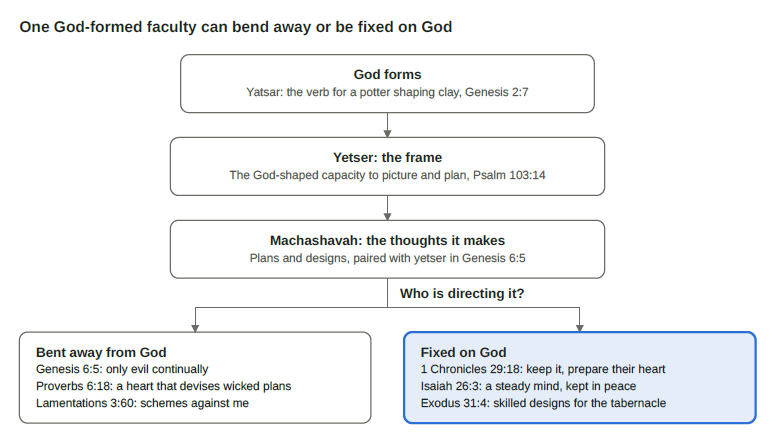
God formed the frame. The picture depends on who’s directing it.
I wrote a short devotion on it, called The Imagination God Formed, and I’d love for you to have it. It’s free.
[Download The Imagination God Formed Devotion]
Real Transformation Happens With God, Not
Around Him
So, you see, my friend, there’s a place in you where God can speak and you can ‘see’ the truth that transforms you. This isn’t about thinking harder. It’s about letting Him change the picture.
So, if you’re tired of “do more, be more, do better,” nothing is wrong with your faith. You may have a body that learned to protect you, and a God who is far gentler about that than you’ve been. He isn’t asking for more effort. He’s inviting you to abide.
More soon, friend.
Leneé
P.S. Missed the earlier Between Seasons entries?
Entry 1: His Back Was to the Track
Entry 3: What Potty Training a Puppy Taught Me About Renewing My Mind
And the podcast is just resting, but I’m sneaking in a bonus episode on December 15, so keep an eye out!
Curious about working together? A few Clarity Intensive spots open in December, and the early listers hears first. [Join the early list here.] You can also email me at lenee@leneepezzano.com with any questions.
Scriptures Mentioned
1 John 4:18: perfect love casts out fear
Galatians 1:6–8: a different gospel
Romans 12:2: transformed by the renewing of your mind
2 Corinthians 10:5: taking every thought captive
Genesis 2:7: God formed man from the dust
Exodus 35:30–35: God filling Bezalel and Oholiab with skill and the ability to teach
Isaiah 26:3: perfect peace for the mind stayed on Him
Genesis 6:5: every imagination of the heart was only evil
Proverbs 6:18: a heart that devises wicked imaginations
Continue Your Journey
Episode 033: Casting Down Vain Imaginations: How God Rewires the Perfectionist Brain. Neuroplasticity, imagination, and renewing your mind with Raven Van Asten.
Episode 005: From Stressed to Blessed: Why Grace Isn’t Just for Salvation. Grace for everyday life, not just the day you were saved.
Neurocoaching is coaching and mentoring. It is not counseling or therapy.